
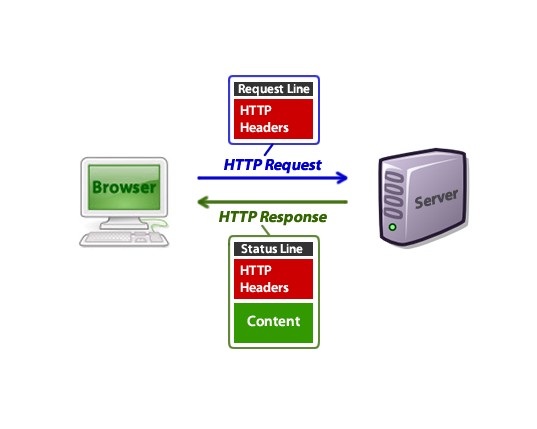
An HTTP response code is nothing more than information sent by the server to the client (usually to the browser), informing how the client's request was handled. A diagram of the client-server communication model:
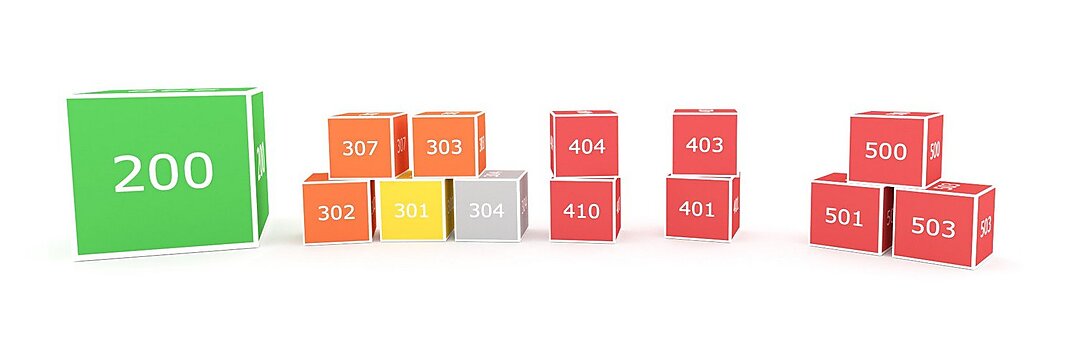
- Classes of HTTP server response codes:
- 1xx - informational codes
- 2xx - success codes
- 3xx - redirection codes
- 4xx - client error codes
- 5xx - server error codes
Informational codes:
| Code | Description | Meaning |
|---|---|---|
| 100 | Continue | request to continue sending the request |
| 101 | Switching Protocols | protocol change |
| 110 | Connection Timed Out | maximum connection time exceeded |
| 111 | Connection Refused | connection rejected by the server |
Success codes:
| Code | Description | Meaning |
|---|---|---|
| 200 | OK | content of the requested document |
| 201 | Created | created - the submitted document was saved on the server |
| 202 | Accepted | accepted - the request was accepted for processing, but its processing hasn't finished yet |
| 203 | Non Authoritative Information | non-authoritative information - the returned information doesn't exactly match the original server's response, but was created from local or external copies |
| 204 | No Content | no content - the server processed the client's request and doesn't need to return any content |
| 205 | Reset Content | reset content - the server processed the request and the client should reset the document's original appearance |
| 206 | Partial Content | partial content - the server only fulfilled part of a GET request; the response must include a Range header informing about the byte range of the returned item |
Redirection codes:
| Code | Description | Meaning |
|---|---|---|
| 300 | Multiple Choices | multiple choices - there's more than one way of handling the given request; the server may provide the address of a resource that allows choosing an unambiguous request among the possible options |
| 301 | Moved Permanently | moved permanently - the requested resource has changed its URI, and in the future the resource should be looked for at the indicated new address |
| 302 | Found | found - the requested resource is temporarily available at a different address, and future references to the resource should be directed to the original address |
| 303 | See Other | see other - the response to the request is located at a different URI, and the client should be directed there. This is the proper way of redirecting in response to a POST request. |
| 304 | Not Modified | not modified - the resource's content has not changed according to a condition passed by the client (e.g. the date of the last version of the resource retrieved by the client - the browser cache) |
| 305 | Use Proxy | Use a proxy server - the requested resource must be accessed through the proxy server given in the Location header of the response |
| 306 | unused code, although reserved for older versions of the protocol | |
| 307 | Temporary Redirect | temporary redirect - the requested resource is temporarily located at a different URI; the response should contain the changed address of the resource, to which the client is required to move |
| 310 | Too many redirects | too many redirects |
Client application error codes:
| Code | Description | Meaning |
|---|---|---|
| 400 | Bad Request | bad request - the request cannot be processed by the server due to malformed request syntax |
| 401 | Unauthorized | unauthorized access - a request for a resource that requires authentication |
| 402 | Payment Required | Payment required - a response reserved for future use (some services already use it) |
| 403 | Forbidden | Forbidden - the server understood the request, but its security configuration forbids it from returning the requested resource |
| 404 | Not Found | not found - the server did not find a resource matching the given URL, nor anything indicating such a resource ever existed |
| 405 | Method Not Allowed | method not allowed - the method contained in the request is not allowed for the specified resource; the response also contains a list of allowed methods |
| 406 | Not Acceptable | not acceptable - the requested resource is unable to return a response that can be handled by the client according to the information provided in the request |
| 407 | Proxy Authentication Required | proxy authentication required - analogous to code 401, concerns access to the proxy server |
| 408 | Request Timeout | request timeout - the client did not send a request to the server within the specified time |
| 409 | Conflict | conflict - the request cannot be fulfilled because there is a conflict with the resource's current status; this response code is only returned when the server suspects the client might not find the cause of the error and might send a valid request |
| 410 | Gone | gone (removed) - the requested resource is no longer available, and its possible new URI is unknown; the client should no longer refer to this resource |
| 411 | Length required | length required - the server refuses to fulfill the request because the request lacks a Content-Length header; the client may repeat the request after adding a correct length header |
| 412 | Precondition Failed | precondition failed - the server cannot fulfill at least one of the conditions contained in the request |
| 413 | Request Entity Too Large | request entity too large - the total length of the request is too long for the server |
| 414 | Request-URI Too Long | request URI too long - the length of the requested URI is greater than the maximum expected by the server |
| 415 | Unsupported Media Type | unknown request method - the server refuses to accept the request because its syntax is not understood by the server |
| 416 | Requested Range Not Satisfiable | the byte range given in the request cannot be handled - the client provided a range in the request that cannot be applied to the specified resource |
| 417 | Expectation Failed | expected value cannot be returned - the expectation given in the request's Expect header cannot be met by the server, or - if the request is being handled by a proxy server - the server has evidence that the expectation will not be met by the next server in the chain handling the request |
Server error codes:
| Code | Description | Meaning |
|---|---|---|
| 500 | Internal Server Error | internal server error - the server encountered unexpected difficulties that prevented it from fulfilling the request |
| 501 | Not Implemented | not implemented - the server does not have the functionality required by the request; this code is returned when the server received an unknown type of request |
| 502 | Bad Gateway | bad gateway - the server, acting as a gateway or proxy, received an invalid response from an upstream server and cannot fulfill the client's request |
| 503 | Service Unavailable | service unavailable - the server is currently unable to fulfill the client's request due to overload |
| 504 | Gateway Timeout | gateway timeout - the server, acting as a gateway or proxy, did not receive a response within the set time from the specified HTTP, FTP, LDAP, etc. server, or a DNS server is needed to handle the request |
| 505 | HTTP Version Not Supported | HTTP version not supported - the server does not support or refuses to support the HTTP version indicated by the client |